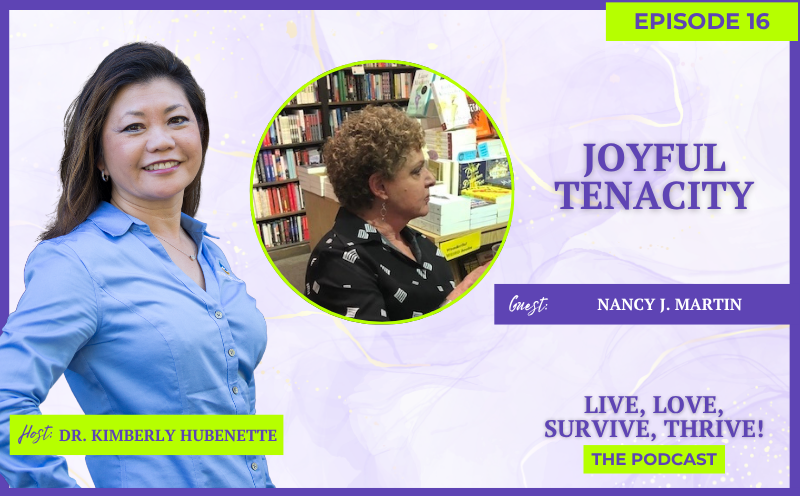
“In my memoir, I talk about planning my suicide, and I had it all planned out, and then things came up, and I did not do that. And so now people tell me, I’m very tenacious, and I try to do it in a joyful manner.”
—Nancy J. Martin
There are moments in life that test everything—your body, your spirit, your will to keep going. And in those moments, what carries you forward isn’t perfection or certainty, but something steadier: a quiet, determined kind of joy.
In this powerful episode, Dr. Kimberly Hubenette sits down with author Nancy J. Martin, who shares her extraordinary journey through a life-altering diagnosis, facial paralysis, abandonment, and the long road of rebuilding a life rooted in resilience, creativity, and connection. Her story doesn’t shy away from the hard parts, but it shines a light on what it means to keep choosing life, even when it feels unbearable.
From her darkest thoughts to embracing what she calls “joyful tenacity,” Nancy opens up about living with visible difference, finding strength through expression, and creating a life filled with meaning, art, and human connection.
If this story resonates, support the podcast and help keep these conversations going.
Key Topics:
- Choosing joyful tenacity in the face of adversity
- Living with visible difference in a judgmental world
- Finding strength through creativity and self-expression
- Moving from despair toward purpose and connection
- The role of community in building a meaningful life
Episode Highlights:
02:05 Meet Nancy: Widow, Author, Jeweler, Thriver
04:14 The Diagnosis That Changed Everything: Acoustic Neuroma
07:12 A Career in Fashion
09:50 Joyful Tenacity: Surviving Facial Paralysis, Abandonment, and Grief
17:35 How Community Heals
21:32 Facing the World Different: Grief, Public Stares, and Choosing Visibility
29:28 Foodie At Heart
Resources:
Freebies
Books
📖Grid: Once in a Lifetime You Get to Start Over by Dr. Kimberly Hubenette
📖Live, Love, Survive, Thrive! by Dr. Kimberly Hubenette (COMING SOON)
Thank you for listening.
To keep my podcast alive,
Wanna buy my dog Dakota a bone?
☕️https://buymeacoffee.com/livelovesurvivethrive
Quotes:
02:37 “There’s only two things in common—we are born and we die, and the journey in between is always different for everybody.” —Dr. Kimberly Hubenette
10:59 “In my memoir, I talk about planning my suicide, and I had it all planned out, and then things came up, and I did not do that. And so now people tell me, I’m very tenacious, and I try to do it in a joyful manner.” —Nancy J. Martin
11:26 “There’s a lot of different types of grief, and grief doesn’t really ever go away, but you can learn to work with it.” —Dr. Kimberly Hubenette
16:15 “You have to learn how to deal with grief. Going through the various stages of grief is a learning experience.” —Nancy J. Martin
20:52 “The more things that you do, you develop community in each of those places. And I think what’s really, really important for living, loving, surviving, and thriving is developing community wherever you go.” —Nancy J. Martin
21:43 “I’m different from most people. I look different, I act different, I am different, and you just have to be the best person that you can be.” —Nancy J. Martin
Meet Nancy:
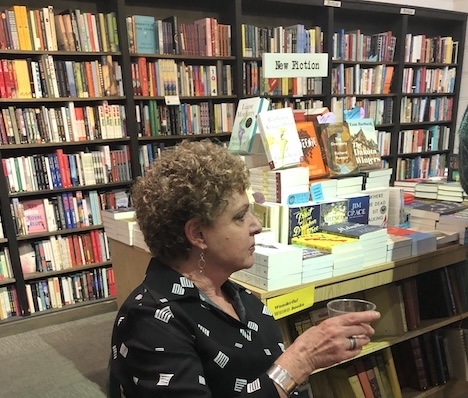
Nancy J. Martin is the author of From the Summer of Love to the Valley of the Moon and The Long Red Hair and Other Short Stories, with a third book currently in progress. Born in San Francisco and raised in Marin County, she later made her home in Sonoma’s Valley of the Moon, where she has lived since 1976. In addition to her literary work, she is an accomplished jeweler and has been a member of the Arts Guild of Sonoma since 2014, reflecting a lifelong dedication to creativity and craftsmanship.
Connect with Nancy J. Martin:
- Website
- Email: nmauthor1@gmail.com
Transcript:
Dr. Kimberly Hubenette: Hi, everybody. This is Dr. Kimberly Hubenette. Live, Love, Survive and Thrive. Welcome to my next episode of Live, Love, Survive, Thrive. So today is such a beautiful day outside. It’s a little cloudy. The weather’s a little bit nice and cozy. Sometimes, maybe it’s a good day to curl up on your couch and watch TV, or watch a special episode of something, or listen to a podcast, or read a book with your cup of coffee or your tea, so I invite you to listen.
I’m glad that you’re here today. We have a special guest, someone I’ve known for a few years, and her name is Nancy Martin. She goes by Nancy J. Martin, and she’ll tell you why in a sec, but I wanted to introduce her to you all. She is also a widow, and she’s had a magnificent life so far. There are things that have happened to her that are so unique. And everybody’s story is unique, right? There’s only two things in common. What we do is we are born and we die, and the journey in between is always different for everybody. So with that being said, I’m going to introduce her, and she can tell you a little bit more.
Nancy J. Martin is the author of From the Summer of Love to the Valley of the Moon and The Long Red Hair and Other Short Stories. She was born in San Francisco, raised in Marin County, and migrated north to the valley of the moon where she has resided since 1976. She’s a published author of two books, and one halfway into a third. A jeweler at the Arts Guild of Sonoma since 2014. This is Nancy J. Martin. Welcome, Nancy.
Nancy J. Martin: Good morning, Kimberly.
Dr. Kimberly Hubenette: Yes, nice to have you on.
Nancy J. Martin: Thank you.
Dr. Kimberly Hubenette: Was there anything that I missed on your author and your life story before we jump into your story?
Nancy J. Martin: Well, my life story is kind of unusual, which is why I wrote the book. People asked me to write a memoir so that I could talk about what an unusual life I’ve had.
Dr. Kimberly Hubenette: Yeah. When we’ve talked before, you told me a few things that I’ve went, wow, that’s really interesting. So I can’t wait to hear your story, and we have a lot of time so we’re gonna jump right into it. Can you take us back to defining moment in your life, one that shifted everything.
Nancy J. Martin: Oh, gosh. Well, that was in 1986 when I was diagnosed with an acoustic neuroma, which is a brain tumor that originates on your acoustic nerve, and that changed everything in my life.
Dr. Kimberly Hubenette: And since it did change everything in your life, was your husband already passed away at that point? Tell the listeners, because our listeners are here to hear a story of survival. Some people are here that they’ve just lost a loved one, whether it be a brother, sister, husband, partner, child, best friend, somebody that was significant to them, and they’re trying to find inspiration of how to move forward.
Nancy J. Martin: Well, I’ve been married three times. Two of those husbands are now passed away, and I’ve also been in some significant relationships where those men are no longer alive. In regard to what happened to me in 1986, I was married at that time, and I had been married for 12 years. They wrapped my head and face up like a mummy, and when they took the bandages off, my husband was horrified, and he left me immediately. So I have a lot of grief stemming from that.
Dr. Kimberly Hubenette: Wow, I actually didn’t know that part.
Nancy J. Martin: I don’t talk about that a lot.
Dr. Kimberly Hubenette: I’m reading through your bio, and it says in the 70s, you’re a hiker. You had some career with buttons at words or something.
Nancy J. Martin: In the 70s, I had a spinning wheel. I would do things like go to the California State Fair and buy prize-winning fleeces, and then spin that wool into yarn, dye it, and sell it in places like the Renaissance Fair. And having always been an avid hiker, I would hike up into the Marin Hills and pick up things like antlers that had been shed by deer, come home and slice them up into beautiful buttons. I also made gorgeous leather clothes and leather handbags. I would use those buttons on those pieces which I sold as fast as I could make them, so I’ve always been a maker, and they call us makers now.
Dr. Kimberly Hubenette: Okay. When you moved to Sonoma, you said that you were in the fashion industry, but you also restored a Greyhound bus depot station.
Nancy J. Martin: I did. In fact if you’re familiar with Sonoma on the west corner of the plaza, there’s a store now in that building called Summervine. Across the street from that is The Girl & The Fig restaurant, and that building where Summervine is had been the Greyhound bus depot of Sonoma, and it was the eyesore of our city. It was really a mess. And interestingly enough, August Sebastiani was my landlord> So when the Greyhound Company left there and the building came up for rent, I took it and restored the building into what you see today.
Dr. Kimberly Hubenette: So it wasn’t yours, but you renovated it.
Nancy J. Martin: That’s correct. August Sebastiani was my landlord. He was still alive then.
Dr. Kimberly Hubenette: Wow. Did he give you money to do it too?
Nancy J. Martin: He gave me a break on the rent every month.
Dr. Kimberly Hubenette: Oh, for doing it. There’s not a lot of renters that would take on that type of responsibility. That’s pretty good. And then the other thing is you said later on your manager for a wine company, and then that’s how you met one of your husbands.
Nancy J. Martin: Correct. So after being in the fashion industry for a number of years, I got the wine bug. Living in Sonoma, it’s hard not to get the wine bug. And I went to Santa Rosa Junior College, which at the time was the educational center for the wine industry in Northern California, and I took everything that you could take from enology to wine marketing there. And when I went out to look for a job, the first winery that I went to was St. Francis Winery, which they hired me to work in the tasting room. I had to clean the bathrooms and work on the weekends, but I kind of made a meteoric rise there. And eventually not long afterwards became their sales manager and national sales manager. And then some years later, I married the Founder, Joe Martin, who has passed away now.
Dr. Kimberly Hubenette: And you mentioned your why of coming on to the show, joyful tenacity when I asked you why you would come on to the show to share your story, can you explain that to our listeners, please?
Nancy J. Martin: Well, Kimberly, due to the fact that at the acoustic nerve where my tumor was removed from, they resected it from there, is very close to the, that’s the eighth nerve, it’s very close to the facial nerve, the seventh nerve. And a lot of people, before they developed the laser knife, which they use now, many people developed paralyzed faces as a result, and mine is very severe. People look at me, little children point at me and make faces at me, and people constantly ask me, what’s wrong with your face? Even today, I’ll get into an elevator and someone will say, what’s wrong with your face? Or everywhere I go, someone says to me, you should see my acupuncturist. Why don’t you get some plastic surgery? Well, I’ve had 40 hours of surgery on my head and face up till now. And actually, I’m coming up on another one to have one of my eyelids restored. In my memoir, I talk about planning my suicide. I had it all planned out, and then things came up, and I did not do that. And so now, people tell me that I’m very tenacious, and I try to do it in a joyful manner.
Dr. Kimberly Hubenette: So the grief that you talk about is the grief of your husband.
Nancy J. Martin: The loss of my personal persona.
Dr. Kimberly Hubenette: Folks, there’s a lot of different types of grief. It could be in all types of forms or stages, and grief can be dealt with. It doesn’t really ever go away, but you can learn to work with it. Would you say that?
Nancy J. Martin: People always say to me, well, you must be used to it by now. But honestly, Kimberly, if I have to look in the mirror or see a photo of myself, and because I’m an author and I do public readings, people often video me. I’m on YouTube, and it’s very, very difficult for me to see myself, so I never get used to it. I have never gotten used to it.
Dr. Kimberly Hubenette: So respecting the fact that you have this situation day to day life, how do you move through the life journey? What did the early stages of grief look like for you? What helped you move through it?
Nancy J. Martin: Well, I guess I should start with that. They talk about different stages of grief. And first, of course, I was very angry because my husband walked down on me instead of supporting me. He left me with no money, and my life went very much downhill from there. So I was angry, and then I would do things. People would say, what’s wrong with your face? And I would say, well, gosh, what do you mean? I would try to embarrass them. Then I realized that that was not a very nice thing to do. So I’ve gone through various stages of dealing with how I deal with the way I look.
Dr. Kimberly Hubenette: But you did mention that you are a widow twice before, so does that affect you also?
Nancy J. Martin: My book does tell the story of my various marriages. And unfortunately, my two last husbands were both very abusive, and so I can’t claim to be grieving about their deaths.
Dr. Kimberly Hubenette: I see. So the first husband was the one that left.
Nancy J. Martin: The first husband, and my pitch for my book is I got married in 1967 in the renowned summer of love to a rock and roll musician in a rock and roll wedding. So my first husband that I married when I was only 19 is still alive, and he and I are still friends.
Dr. Kimberly Hubenette: I see. But you removed yourself from him.
Nancy J. Martin: Yes, I did. And the book tells why. I don’t want to do too many spoiler alerts here. You kind of have to read the book, but we are still friends.
Dr. Kimberly Hubenette: And then the second late husband?
Nancy J. Martin: Is the one that left me when I was so ill.
Dr. Kimberly Hubenette: And then the third husband?
Nancy J. Martin: Was Joe Martin from St. Francis Winery. And unfortunately, he was bipolar and didn’t want to take medication. Anyone who’s ever dealt with anyone who was bipolar can understand what that means.
Dr. Kimberly Hubenette: Okay, okay. Good. I’m glad you kind of clarified because I was a little lost about all three of these people. I do have a question about what helped you move through your grief. Did you answer that one already?
Nancy J. Martin: Well, originally, when I was planning my suicide, I called a suicide hotline, and they suggested that I join a meditation group. And I did that. And due to various other circumstances in my life was dealing with people who were addicted to drugs. And so I did two things. I joined a meditation group, and I started going to Al-Anon, which totally changed my life. The Al-Anon principles have really shaped my life. And for many years, I was an Alateen sponsor. I worked at a rehab center where, because I was a fitness trainer for so many years, I worked with the recovering addicts, helping them with exercise and those kinds of things.
Dr. Kimberly Hubenette: You’ve lived with this for a very long time. How many years have you lived with this diagnosis and the treatment?
Nancy J. Martin: 1986.
Dr. Kimberly Hubenette: Yeah, that’s a quite a bit of time.
Nancy J. Martin: I was 38 years old. I’m 78 at this point.
Dr. Kimberly Hubenette: How has your experience with grief shaped or reshaped your view of life purpose, or even identity?
Nancy J. Martin: Well, you have to learn how to deal with grief, as you mentioned. And so going through the various stages of grief is a learning experience, of course. Everyone does it differently, as you said. So for instance, instead of committing suicide, I started meditating and going to Al-Anon. So everyone does it differently.
Dr. Kimberly Hubenette: There’s different kinds of grief, right? We talked about that. And if you did lose your loved one, it might have been a freeing experience instead of a non-freeing experience. You said that your husbands that have passed were kind of abusive, and so you’re not grieving that part of it. But you’re grieving more of your process of your paralyzed face from the neuroma, right? See, folks, there’s different ways and different things, and we just love to hear stories about how you survive, how you thrive and live again. What does living fully mean to you now, Nancy?
Nancy J. Martin: Well, I try to start off my day often by jumping into a swimming pool and doing deep water aerobics. And after an hour of that, that really will make your day clean, refreshed, and energized.
Dr. Kimberly Hubenette: What practices or habits are people supporting your transformation is the most, you said that there are things in your past, but are there things now that people who have helped you transform supported you in your transformation of your life?
Nancy J. Martin: Sure. But I would like to say that having been a lifetime equestrian, always having horses and maintaining my horses myself as opposed to boarding them and riding since I was a small child taught me a real sense of responsibility, which I talk about in my book, and really enriched my life in a very big way, my life with horses.
Dr. Kimberly Hubenette: Yeah. Horses actually are very soothing. They can read people. I went to this horse ranch in Petaluma a few years ago, and the owner, their premises like to work with children or people that have situations where they need to, maybe they can’t speak, or they have autism, or something like that, and they are able to read the horses, or they learn how to work with the horses.
Nancy J. Martin: There’s a wonderful organization there called Giant Steps, and I believe that’s what you’re talking about.
Dr. Kimberly Hubenette: Yeah, maybe it is. We went there. It was really interesting because I took my dental staff to work as a team to learn how to read people without having words, just the horse. It was really interesting to read body language and that kind of thing. That was great. You mentioned a lot of things, interesting things about life, and the things about living, loving, surviving, thriving out. Followed those scenarios, have you learned to live, love, survive, and thrive?
Nancy J. Martin: I would have to answer yes to that. I am very domestic person. I just love gardening. For instance, watching things and helping things grow. I’m a serious foodie. I love cooking. And having been a fitness instructor for the big majority of my life, I’m really into exercise and encouraging others to do that. And I’m also a member of the Arts Guild in Sonoma where I’m a jeweler. I am a volunteer docent at Jack London State Historic Park where I’m very active there. I’m doing a lot of different things there in the park. And so the more things that you do, you develop community in each of those places, and I think that that’s really, really important for living, loving, surviving, and thriving with developing community wherever you go.
Dr. Kimberly Hubenette: That’s a great one. Do you think that helped you tremendously in your life as doing extra things with the community and basically friendships long term, lifetime friendships that you’ve created?
Nancy J. Martin: Immeasurably, that’s priceless.
Dr. Kimberly Hubenette: Is there anything else that you think that the listeners want to hear about yourself? And tell us a little tip that makes your story unique.
Nancy J. Martin: Oh, gosh, well, I’m different from most people. I look different. I act different. I am different. You just have to be the best person that you can be.
Dr. Kimberly Hubenette: It sounds like even though you have had this all your life now, well, since you were 36, do you think that going out with the public and doing all this other stuff affected the way that you choose to see yourself?
Nancy J. Martin: That is a really good question. I left to my own devices. I would just stay home. But instead, I choose to go out into the public. And for instance, being a docent at State Historic Park, I have to interact with people from all over the world, and I noticed that as soon as they start talking to me, all the weird feelings that they might have about the way I look seem to disappear. Of course, I work at the Arts Guild. I am an artist member there since 2014, and so I’m in retail sales there. And again, I have to interact with people from all over the world, and same thing, people say weird things to me. But if they do, I respond the best way I know how.
Dr. Kimberly Hubenette: What drives you to be in the public instead of stay at home?
Nancy J. Martin: It’s more fun. It’s definitely more fun to be out there. One of the residual effects of my surgery, because they had to remove my acoustic nerve from my left ear, is that I am legally deaf. And that is not fun. It’s very challenging, and so being deaf is very isolating. I do have what they recently developed a two-sided hearing aid, which picks up all the sound from my deaf side, and sends it all over to my hearing side. But if I’m in a noisy environment, then what I’m hearing is cacophony. So all these things you have to adjust to, and what are you going to do? You have to adjust to it.
Dr. Kimberly Hubenette: At least you can hear some things, right?
Nancy J. Martin: Yes, I can.
Dr. Kimberly Hubenette: And so you said that you have two books and one on the way.
Nancy J. Martin: Correct. My second book, a book of short stories, the long right here, and Other Short Stories now has, it’s won a number of awards. It has two gold medals and a silver medal, and it’s gotten rave reviews. And the first book was awarded five stars by Writer’s Digest, which is the most prestigious writing journal in the United States.
Dr. Kimberly Hubenette: Yeah, because you had a very interesting story. We don’t want to spoil it for the listeners if they want to buy the book, but is it on Audibles?
Nancy J. Martin: Yeah, it’s on audiobook. The book is available, of course, on Amazon, as everything is. And then locally, you can find the book at Readers Books in Sonoma, which happens to be right next door to the Arts Guild of Sonoma where I also always have the books. It’s available at Copper Fields in Santa Rosa.
Dr. Kimberly Hubenette: That’s interesting. Are those true stories or not?
Nancy J. Martin: The memoir, of course, is an entirely true story. There are memoir pieces in the short stories. There is a fiction essay, a little bit of everything in the short story book, and it’s humorous. There’s a lot of horse stories in there, lots of different kinds of things.
Dr. Kimberly Hubenette: And then I know you can’t really tell us much about your third book that is almost written.
Nancy J. Martin: It’s a very unusual dark topic. And people, if I happen to tell them, which I’m not going to reveal here what the topic is, ask me why I’m writing about such a dark topic, and my answer is someone has to write about that.
Dr. Kimberly Hubenette: I see. Okay, that’s intriguing. Really intriguing, Nancy.
Nancy J. Martin: Thank you.
Dr. Kimberly Hubenette: So since I’ve known you for a while, I’m glad that we had this conversation, and you came on to our podcast. But is there anything else that you want to share with our listeners?
Nancy J. Martin: If they would like to see some photos of me, they can go to my website, which is nancyjmartinauthor.com. That’s N-A-N-C-Y-J-M-A-R-T-I-N .com. I always use my middle initial because there are numerous authors by the name of Nancy Martin.
Dr. Kimberly Hubenette: Got it.
Nancy J. Martin: On the audio book, there’s a live interview with me, and lots of information about me.
Dr. Kimberly Hubenette: Yeah. I would love to see pictures of you in the 80s. I would love to see pictures of you in your rock star years.
Nancy J. Martin: Oh, they’re in there, starting with a picture of me on a horse when I’m like, I don’t know, four years old up. There’s pictures of me at my wedding at St. Francis Winery with my late husband, Joe Martin, with lots of photos in there.
Dr. Kimberly Hubenette: Interesting. These local things that are around here, people want to hear maybe some of these local stories, and it just brings back nice thoughts. When I think about St. Francis Winery or other places that you have restored, the places that you’ve worked, it’s really interesting to hear. I want to read that book. I actually want to read both of those books. They sound very interesting.
Nancy J. Martin: Thank you.
Dr. Kimberly Hubenette: And so, folks, this is Live, Love, Survive, Thrive, and it’s been such an honor to talk and interview Nancy J. Martin and hear a little bit about her story. These podcasts are here to help you hear stories of grief, how to overcome it, and actually what they’ve gone through to thrive again in life. If you want to keep hearing stories about these, I have this little link on my website called buymeacoffee.com/livelovesurvivethrive. I always say, hey, buy my dog a bone. That just kind of helps us keep our podcast going and strong. If you like to hear more about those stories, please donate to the cause of give my dog a bone, if you want to. buymeacoffee.com/livelovesurvivethrive is the website. It’s been such a great honor to have you here, Nancy. Tell the listeners, do you have a favorite food or recipe that you like to share with us today? What’s your favorite go-to?
Nancy J. Martin: Well, I’m a chocoholic, there’s no doubt about that. I have to be careful with that. And in general, I’m a serious foodie, and I just love to cook. But I haven’t eaten any red meat since I was a teenager, so I could easily be a pescetarian.
Dr. Kimberly Hubenette: There you go, ladies and gentlemen. This was the episode of Live, Love, Survive, Thrive with Nancy J. Martin, and I’m going to sign off now and say bye to you all. This is Dr. Kimberly Hubenette saying bye.
Nancy J. Martin: My pleasure. Thanks for having me, Kimberly.
Dr. Kimberly Hubenette: And Nancy Martin, saying bye for now.