
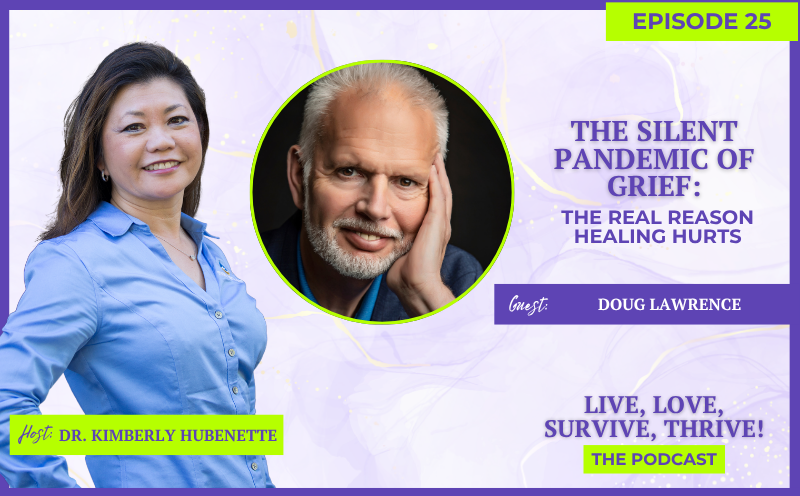
“Somebody will be there to help you with your healing journey, but it only starts when you actually come out of that closet and actually ask for help.”
—Doug Lawrence
Grief after losing a spouse doesn’t have to be faced alone. Discover how one widower turned loss into a life of purpose, service, and healing.
Grief After Losing a Spouse: An Honest Path to Healing
Grief after losing a spouse rarely looks the way people expect. There’s no clean timeline, no single moment when it’s “over” — just the slow, uneven work of rebuilding a life that used to include someone else in every part of it.
That’s the reality Doug Lawrence describes after losing his wife Deborah to cancer following 43 years of marriage. Deborah handled the bills. Doug handled the chores. When she died, he inherited both, along with a grief he wasn’t prepared for and didn’t fully understand.
Rebuilding Life One Task at a Time
Doug’s early grief wasn’t abstract — it showed up in grocery store aisles, buying gift cards the way he and Deborah always had, and suddenly feeling overwhelmed in public. Relearning basic routines became its own kind of grief work, something he says people rarely talk about openly.
Why Asking for Help Matters Most for Men
Doug is a certified grief mentor, but seven out of eight of his clients are women. He believes men are conditioned to avoid asking for support, and he pushes back on that directly, describing the shift as “coming out of the closet” — extending a hand and admitting you need help, rather than carrying grief alone.
Grief as Proof of Love
The line Doug returns to again and again is simple: grief exists because love existed first. For him, that reframes grief entirely — not as a problem to solve, but as evidence that a relationship mattered. He also doesn’t dismiss the idea of remarrying, encouraging others not to treat moving forward as disloyalty to who they lost.
Coping with grief after losing a spouse isn’t about reaching a finish line. It’s about finding small, sustainable ways to keep living — and, for Doug, finding purpose in helping others do the same.
To hear Doug’s full story, including the moment he first learned Deborah was sick, listen to the complete episode: https://tinyurl.com/Live-Love-Survive-Thrive
Episode Highlights:
05:16 Meet Doug Lawrence: Certified Grief and Journey Mentor
05:56 The Diagnosis That Changed Everything
06:55 Family, Grief, and Holding It Together
09:43 Relearning Life After 43 Years of Marriage
11:18 How Loss Reshaped Doug’s Purpose and Identity
13:10 Advice for Anyone Starting Their Grief Journey
16:21 Inside His Rare Journey Mentor Certification
18:47 On Remarrying and Moving Forward After Loss
26:08 Lessons From Grief: The Silent Pandemic
30:20 Final Takeaway: It’s Okay to Ask for Help
Resources:
Books
Get Doug’s Books
📖You Are Not Alone: Mental Health Mentors Take the Journey with You
Get Kim’s Books
📖Grid: Once in a Lifetime You Get to Start Over by Dr. Kimberly Hubenette
📖Live, Love, Survive, Thrive! by Dr. Kimberly Hubenette
Thank you for listening.
To keep my podcast alive,
Wanna buy my dog Dakota a bone?
Quotes:
06:34 “You always extend the element of hope, and in our case, hope never made the journey, and I ended up in a lot of situations. I had to rewrite my life as I knew it, so that I could continue to move on.” —Doug Lawrence
13:14 “Don’t be afraid to reach out and ask for help. You don’t need to go on the healing journey by yourself.” —Doug Lawrence
16:08 “Somebody will be there to help you with your healing journey, but it only starts when you actually come out of that closet and actually ask for help.” — Doug Lawrence
23:00 “When you help other people, you take on some of their energy. Thus, what I need to be constantly reminding myself is that I have to do the self-care part to make sure that I’m watching out for myself.” —Doug Lawrence
25:02 “If I can get everything in alignment with the way that it needs to be, with the way the universe wants, I’m going to be in a place where I can thrive.” —Doug Lawrence
28:39 “In the grief journey, everybody’s in their own time frame.” —Dr. Kimberly Hubenette
29:53 “Had you not had the love, you wouldn’t have experienced the grief.” —Dr. Kimberly Hubenette
Meet Doug:

Doug Lawrence is the only one to hold the Certificate of Practice-Journey Mentor provided by the International Mentoring Community (IMC) in the world today. A trained Journey Mentor is a mentor of mentors working to assist people navigating the certification process provided by IMC. The Journey Mentor plays a significant role in being part of the support structure for mentor health. This requires that the Journey Mentor be able to provide a deeper, richer mentoring experience.
Doug works with organizations that have high employee turnover, low productivity, and a shaky bottom line with his Culture Assessment process. Doug interviews employees and managers to get a snapshot of the organization’s culture and get it back on track. The Culture Assessment assists Doug in determining whether or not the organization is ready for mentoring.
Transcript:
Dr. Kimberly Hubenette: Hi, everybody. This is Dr. Kimberly Hubenette, and this is our next episode of Live, Love, Survive, Thrive. I’ve been off on vacation for a little bit, so I wanted to come back and say hello and tell you about my experiences. I just walked part of the Camino de Santiago in Spain, and I did about three and a half days worth of walking 15 miles per day, and it was amazing. And if anybody wants to do that type of a walk, a retreat, it’s so wonderful and beautiful to get back to nature and meet people along the way. And the pilgrimage to Camino de Santiago was amazing because I know a lot of people are starting to want to do that now. Anyway, I had a great trip, and I lit some candles-one for my mom and one for my husband, my Mark that passed away in 2019 when I arrived there, and all the cathedrals were so beautiful. But to say the least, I’m back, and I wanted to also remind everybody that we’re doing a retreat this coming week in Sonoma Regional Park in Sonoma, California. So hopefully, you still have time to book your time and come see us. On that note, I have a special guest today that I wanted to introduce. His name is Doug, and I want to tell you a little bit about him. He’s a widow. He had a wife that passed away from cancer, and I’ll let him tell more about that. But the unique thing about him is he holds the only certification for what he does, and so he’s an author. He’s written a book that has five awards so far, and I’ll let him talk about that as well. So his name is Doug Lawrence, and he’s the founder of TalentC, and has focused on all mentoring as a solution provider. Doug is an international certified mentor and holds two mentor certifications: Certificate of Practice Mentor and the Certificate of Practice Journey Mentor from the International Mentoring Community. And like I said, he’s the only one to hold the Certificate of Practice Journey Mentor in the world today. That’s amazing, and I’m so happy that he’s had time to spend with me on this podcast of Live, Love, Survive, Thrive. He’s a thought leader, and he’s authored the book entitled “The Gift of Mentoring.” And his second book, “You Are Not Alone”, became Amazon number one bestseller in North America and the UK, and also is a bronze medal global award. He also has grief, the silent pandemic, which that one reached five global awards. So it’s amazing that he has time to share with us. So with that being said, Doug, welcome.
Doug Lawrence: Well, thank you very much. I appreciate the opportunity to have a bit of a discussion with you. Yeah, thank you.
Dr. Kimberly Hubenette: I mean, you’re an amazing guy. You’ve had all this stuff happen to you, and then yet you’re still thriving. With this podcast, Live, Love, Survive, Thrive, you know, we try to get people to think about what could be if they’re stuck or if they’re learning to thrive, just like yourself. Can you take us back to a defining moment in your life, one that shifted everything for you?
Doug Lawrence: I think that for me was when my dear sweet wife Deborah passed away from cancer. Everything changed for me when that took place. It was the recognition that, oh my gosh, you know, I typically refer back to when the doctor walked into the emergency room, looked at both of us, and said, “Deborah has cancer.” You could have heard a pin drop in the examination room, just because that was not the message we had thought that we were going to be given. You know, you always extend the element of hope, and in our case, hope never made the journey, and I ended up in a lot of situations. I had to rewrite my life as I knew it, so that you know I could continue to move on.
Dr. Kimberly Hubenette: Usually, the women of the family are the ones that bring everything together. Is that the same for your family? I mean, did you have kids? Did you, you know, what was that like?
Doug Lawrence: You know, we had a very close knit family: two children, a boy and a girl, a young man, a young woman, grandchildren, and we had this deep, deep love for each other, and we shared everything that, you know, everything we were doing we shared together. Like so, when I would go now to the grocery store to buy gift cards, I would be standing there, and because it was something that we had done together so much, I became extremely emotional and had to deal with that, you know. And some people, what’s wrong with the with the old guy that’s you know shedding wise he crying? There’s nothing to cry about, and yet when they hear the story, they too shall cry. So, to specifically answer your question, we did a lot of stuff together, and like I had mentioned before, we started to show what the aspect of she was my support structure. She was the person I went to when I needed advice and guidance, or when I needed, you know, just basically support. She was the person I went to, and now I had none of that.
Dr. Kimberly Hubenette: Yeah, I know. When my mom died, my dad like totally like shut down. He didn’t do any of the bills, so his water shut off three times, his telephone shut off a couple times, the electricity shut off a few times, and we tried to get him to do automated, you know, bill pay, and he had did not want to have anything to do with that. So he says, “I’m going to pay my own bills. I’m going to, you know.” So what happened is he was running a dental office, and his secretary, we just told her to start paying the bills for him because he just totally shut down. He even stopped paying his taxes. Like I don’t know what he thought, but he was that devastated when my mom passed away. They were married for 47 years, and same thing- all of this, you know, grandchildren, you know, children, family, tight knit. But she was the one that kept, you know, things together. So I commend you.
Doug Lawrence: Yeah. You know, it was 43 years of marriage, and you’re right. You split what you’re doing. So Deborah used to pay all the bills, and I would take care of the chores around the house and stuff like that, and then that had to all change. I had to take on not only the stuff I was doing, but now I had all these bills I had to pay, and I didn’t have a clue what I was doing.
Dr. Kimberly Hubenette: So, you know, we talk about obviously the grief, but was there any types of gift that brought you back, like with her passing and things? How did that change your life in a positive?
Doug Lawrence: In a positive?
Dr. Kimberly Hubenette: Was there any positive?
Doug Lawrence: There wasn’t a there wasn’t a lot of positive that come out of her passing. I guess the one thing was it did bring the family a bit closer because, you know, they had to take care of me, so that you know there was that sort of thing going on. But when I think of the life that we had and all the things we were doing, there wasn’t much of it that was positive.
Dr. Kimberly Hubenette: It was a struggle. So how do you think your experience with grief reshaped your view of life, your purpose, and even maybe your identity?
Doug Lawrence: My purpose has shifted to not only do I want to take care of myself and set aside time for that, but I want to be able to do that for others. My belief is that I can help as many people as I possibly can, even if it’s one person at a time. But it’s to be able to help them to let them see that we do care and that we do want to help them go through dealing with on their grief journey, going through and dealing with it, so that they know that they are not alone.
Dr. Kimberly Hubenette: And did you write before she passed during the time, does that inspire you or after she passed?
Doug Lawrence: So it was a kind of a combination of the two. The second book, “You Are Not Alone”, I was into the writing of that book quite a bit, and then when she passed that was sort of the catalyst that made me decide that I needed to the grief part. I needed to write about that. So book number three, which is “Grief: The Silent Pandemic”, was actually the inspiration, if you want to call it that, to write that book came from her passing,
Dr. Kimberly Hubenette: And you know, obviously, you had a career in the police academy or something, right? I read about you, and so this next chapter of your life, where you’re writing and then you’re coaching. If someone is listening, you know, and just at the beginning of their healing journey, what would you tell them?
Doug Lawrence: You know, if they’re at the beginning, is don’t be afraid to reach out and ask for help that, you know, you don’t need to go on the healing journey by yourself. That you know, have a conversation with any type of a conversation. You just need to let people know that you need help and that they can reach out, and hopefully they’re the sort of person that will help you deal with the grief that you’re struggling with. That’s for me. I know I find that to be sort of a godsend at times where I’m struggling and I’m not sure what to do. I have a small circle of friends that I can go to and say, “I need you to listen because I’m really I’m fighting a battle uphill.
Dr. Kimberly Hubenette: And most I would say of my people that I interview, they’re females that are pages. This is unique that you’re a male, and with your certifications, you’re the only in your field for these certifications. Do you have mostly men as your clients then, or like, because sometimes it’s hard for a man to express or ask for help. I’ve noticed. Do you feel that way too?
Doug Lawrence: I actually, you know, to be truthfully honest, the majority of the people that I work with are female.
Dr. Kimberly Hubenette: Ah, do you feel like there might be like the guys that don’t want to know or don’t want to– were you in that category? Before you got into this, or were you unique in that you always wanted to ask for help?
Doug Lawrence: Because I know that when Deborah passed, I remember I had a tough goal for a while, and I had to reach out and get counseling. And the counseling I got was from from a female, she was very, very, very good at what she did. Because when I think back to who I have right now for people that I’m working with, there’s probably seven out of eight of the client base. Seven out of eight would be female,
Dr. Kimberly Hubenette: And what about for the men out there listening? Do you have?
Doug Lawrence: Yeah, my advice to males is that, and I’ve been there, so I know what it’s like. Is that you need to come out of the closet, as I describe it. You need to come out of the closet and extend your hand and say, “I need help,” and somebody will be there to help you. Somebody will be there to help you with your healing journey and stuff like that. But it only starts when you actually come out of that closet and actually ask for help.
Dr. Kimberly Hubenette: What is unique about the certification that you’re the only one that holds? Can you explain that to us? The
Doug Lawrence: The reason it is that I’m the only one that actually has it is that it’s a fairly involved, fairly in in depth certification, and I think that has quite possibly scared people away from actually pursuing it because it did take a lot of work to do, and I’ve since added to the mix. I’ve actually had my fellow designation as a as a mentor, and so if I add all of that together, like the mentoring certification was probably about six years of fruit to to get to the point where I’m the only one, and then probably three years for the fellow designation to come through. I had to do case studies and a whole bunch of other things, but part of it is a lot of this, as you well know, is can be considered to be that touchy-feely sort of atmosphere, and for some guys, that’s just not in their their Baileywick. where I actually have great success with working with with females.
Dr. Kimberly Hubenette: Yeah, the dynamics of female-to-male and then male-to-female might be the thing that catapults people to move forward, because maybe sometimes females like to talk to males better, and males maybe like to talk to females better. I don’t know, but all I know is it was hard for my father to, like, meet those challenges also, and you know, he got remarried within a year- well, a year and a half, I would say. Do you think that people can heal themselves enough to go on to a next relationship that fast normally, or did they suppress something? I’m not exactly sure about that.
Doug Lawrence: Yeah, I don’t know because when my dad passed away, he remarried after I think it was seven or eight years, and my mom, well, when she passed, right from she was in palliative, and passed right from palliative, so there wasn’t– I don’t think my mom would have been the sort of person that would remarry. I think she would have been quite content, taking life in its stride the way it was. So it’s hard to say, like, and yet I know you know some folks here, even some that are part of support groups that I belong to that there’s a connection there with with people that we sometimes just don’t pick up on, but they seem to have found the support that they want by remarrying or getting engaged or any or all of those. So I know that if I were to look at it, I would say that if the right person comes along, I would definitely entertain, you know, remarrying, but at this particular stage, I’m still battling with the grief issues.
Dr. Kimberly Hubenette: And before she passed, did she ever tell you to date again, or did you never even talk about that?
Doug Lawrence: At the time, she got sick and was quite ill in the hospital, and it appeared as though she was going to pass. We never really explored that, and I’m going to share this just because it’s truthful. It happened that I went to a medium who made the connection for me with Deborah and my dad and all of some family members, most of whom had passed on. And in that session, Deborah had come forward and had said that she wanted me to very strongly consider remarrying because she said that I shouldn’t be living by myself, which scares me, which tells me that something’s not right. But what I had done with with my mom and with Deborah was I had gone to a psychic or a medium in both cases, and I was primarily doing it because I wanted to make sure that they were okay where they were, that they had feel pardon the expression crossed over and had settled into their their new life, and it was in the second or third session with the medium, that she, Deborah, come forward in that session, and and basically it said you need to remarry when you find the right person, and if you need my blessing, you have it to go forward. So, and that’s-I mean, that’s just who I am as a person.
Dr. Kimberly Hubenette: Yeah, me too. I mean, for me, since my husband passed away in 2019, I’ve been on one coffee date, which was ended up in a disaster. But other than that, there’s no desire still in my journey of life and grief, and I’m okay with it at this point. But if, like you’re saying, if the right person came along, I maybe consider that. So, how has your pain turned into purpose? Are there ways you’re now serving others because of your journey? Can you tell us a little bit about that?
Doug Lawrence: I’m helping others because there’s a definite need to do so, and it’s a matter of, as you well know, when you help other people, you take on some of their energy, or we’ll call it energy. And what I need to be constantly reminding myself is that I have to do the self-care part to make sure that I’m watching out for myself. And there will be times where I just need to say no because it’s adding far more negative energy than what I can manage at that particular time point.
Dr. Kimberly Hubenette: So when I always ask my listeners because of the theme question of Live, Love, Survive, Thrive, what does that mean to you in this season of your life?
Doug Lawrence: It’s a combination of things. You know, you look at it from the aspect of of living. You know that you still have that family support group that is there to help you as you continue to to move forward. And so there are elements of where you still have a life to live, and you still have lots of love to share with other people, and you know to leave that by the roadside and not take advantage of that love that everybody else is wanting to share with you. I think that’s a mistake. Survive, you know. When I look at that’s probably out of all of the ones that you mentioned, the surviving part is the one that I think causes me the most, the biggest challenge is, and it’s just because I need to make sure that I’ve developed the coping skills so that I can move forward as best I can in dealing with the grief that I find myself absorbing more than anything else. And then if I can get everything in alignment with the way that it needs to be with the way the universe wants, I’m going to be in a place where I can thrive, you know, certainly being able to to move forward at the pace that I need to move forward in order to get back on track with my healing journey.
Dr. Kimberly Hubenette: What would you say you thrive in the most at this point in your life?
Doug Lawrence: I think what I thrive at the most, what I need the most, is the podcasts are very therapeutic for me, and so the more that I do, the more that I get to share my story the more I share Deborah’s story, I think that that’s where I definitely thrive.
Dr. Kimberly Hubenette: Can you give us a little tips or something out of your books, and what would you like to share with the listeners that might help them from your book or books?
Doug Lawrence: Well, the one is certainly the grief, the silent pandemic. I think there’s all kinds of tidbits and stuff I go through here, and I explain the significance or importance of a support structure. I explain the different types of grief that we end up encountering. I share some lived experience in there. Some stories about Deborah, like the one I mentioned earlier about her in the emergency room. I share those stories openly and freely with people because that way, if they’re listening and hearing the messages that I’m putting out there, those messages are going to help them in their journey in dealing with their grief, similar to what I went through when I was trying to identify coping skills for myself and and identifying ways that I was going to be able to get myself back on track, so that I could actually move forward with the healing journey.
Dr. Kimberly Hubenette: And where can they get these books?
Doug Lawrence: Amazon. There’s three books: The Gift of Mentoring, You Are Not Alone, and Grief: The Silent Pandemic. All three are available on Amazon.com or .ca, whichever one. So yeah, they’re all available there.
Dr. Kimberly Hubenette: You know your book that you just showed us. It’s like a manual, actually. Is it like a manual?
Doug Lawrence: No. It there’s just a lot of content that we put into this. When I compare it to You Are Not Alone, there’s definitely well, it’s about a 40 to 50 page difference.
Dr. Kimberly Hubenette: And is it consecutive? You have to read the first book before you get to the second book to the third book?
Doug Lawrence: No, no.
Dr. Kimberly Hubenette: Okay. I mean, a lot of our listeners they’re always looking for things to search and how to help themselves and heal themselves, and you know, a lot of our listeners enjoy hearing, you know, people that might have been like their story, or might have had a tidbit to help them, you know, move forward to the next step, and also in their grief journey. Everybody’s in their own time frame. Is there an actual quote that you live by that might help somebody else as well?
Doug Lawrence: I actually have one here. Grief exists because love existed first.
Dr. Kimberly Hubenette: Oh, that’s a good one. Say it again.
Doug Lawrence: Grief exists because love existed first.
Dr. Kimberly Hubenette: That’s deep.
Doug Lawrence: Very deep.
Dr. Kimberly Hubenette: How does that help you? What does that mean to you?
Doug Lawrence: If I get stuck, and it happens more often than not, it gives me a sense of or a reason why grief is in our lives today, is because we had, and I use Deborah as my example, Deborah and I had this deep and meaningful relationship, and the grief that I’m experiencing now was because of that love that we shared together.
Dr. Kimberly Hubenette: And had you not had the love, you wouldn’t have experienced the grief.
Doug Lawrence: Exactly.
Dr. Kimberly Hubenette: That’s pretty deep. It’s, you know, back, you know, thinking about emotions before and after.
Doug Lawrence: Yeah,
Dr. Kimberly Hubenette: Interesting. Is there anything else that you would like to share with the listeners before we talk about our food experiences?
Doug Lawrence: You know, just the the most important thing as a takeaway from today is that it’s okay to cry, and that it’s you need to be comfortable in reaching out and asking for help, and you need to listen and hear what the other person is saying because they’re wanting to open up and share what’s going on inside their body, and they need somebody to lean on in order to be able to do that. And that can very much be, you know, be you. So it’s a matter of coming out of the closet and asking for help.
Dr. Kimberly Hubenette: Well said. Well said. Like I mentioned before, we started recording. I always like to ask my interviewees, tell me your favorite food that keeps you in comfort. Like, do you have a recipe for it? What makes you happy?
Doug Lawrence: So you have to understand that Deborah did all the cooking and I did the housework. So in that particular case, for me, because part of my cooking experience was barbecued steak, so that would definitely be the one. And and I’ve been able to to experiment and find out that you can actually do a barbecued steak in an air fryer.
Dr. Kimberly Hubenette: Oh, really nice! And it takes a shorter time.
Doug Lawrence: Yes. Does it
Dr. Kimberly Hubenette: Taste the same?
Doug Lawrence: So the one recipe that I have is olive oil. So you marinate it in olive oil, and then you add steak spice, and then it’s a matter– I’ve what I’ve done is cut it into slices, so it’s almost like pulled pork, but it’s not quite. And then just do that, I think it’s about 10 minutes in the air fryer on about 400. I think is if my memory 404 20 thereabouts, and it crisps up nice and crispy, and it is actually very good.
Dr. Kimberly Hubenette: Oh, good! That sounds good. I have an air fryer, and I’ve been experimenting with my air fryer too. So I’m going to try that recipe.
Doug Lawrence: Yeah, it it depends if you have that love of steak. A lot of people, you know, can’t be steak is “no, I don’t like that.” But I found that it it actually, when I cook it that way and cut it into strips, it actually cooks up nice and what it it’s it’s not tough. It’s you know, it’s very juicy and very tender. So give it a whirl and let me know.
Dr. Kimberly Hubenette: All right, I will. Well, it’s been so nice to get to know you, Doug, and have a wonderful rest of your week. And to the listeners out there, I hope that you enjoyed as much as I did Doug’s story, and your presence in life-it all makes a difference. Thank you so much for having the willingness to come and talk to my listeners.
Doug Lawrence: Thank you for the opportunity. I enjoyed it immensely.
Dr. Kimberly Hubenette: Thank you. Okay, all. See you next week on Live Love Survive Thrive. Make it a great day.