
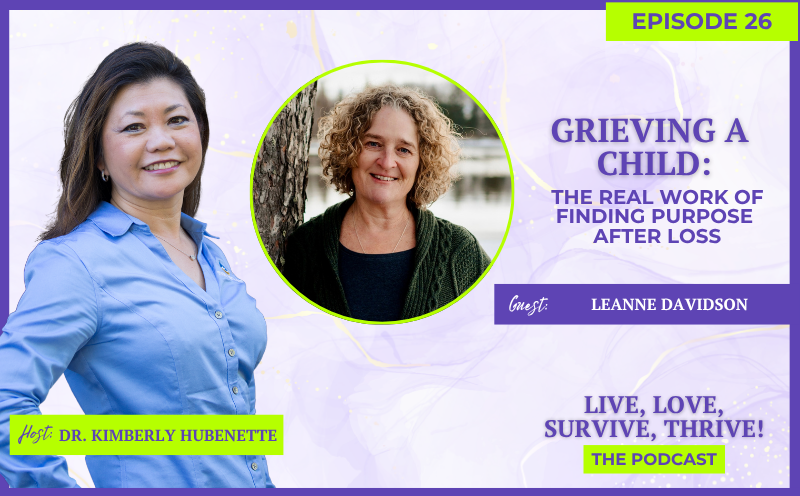
“I’m still grieving, I’m still hurting, but I can still put something out there to help other people. I can still include other people in my journey and hope that it helps them in their journey.”
—Leanne Davidson
Grief after losing a child rarely follows a straight line. Author Leanne Davidson shares how faith, writing, and honesty helped her find purpose again.
Grief After Losing a Child: A Mother’s Honest Story
Grief after losing a child doesn’t arrive on a schedule, and it doesn’t end once the funeral is over. Author and grief mentor Leanne Davidson knows this firsthand. Her son Michael died of a drug overdose in 2022 after years of fighting addiction — and in the years since, she’s turned her grief into a ministry that helps other parents feel less alone.
Two days after Michael died, Leanne remembers lying in bed and praying one simple sentence: “God, I can’t do this. Help me.” That moment became the starting point of a journey that eventually produced two published books, a blog, and grief support groups she now facilitates for others walking the same road.
Writing as a Path Through Grief, Not After It
Leanne began journaling about four months after her son’s death — not once her grief had eased, but while she was still deep inside it. Those entries became her first book, A Beautiful Pain, followed by a 30-day devotional, Tattered Hearts and Hopeful Souls, written specifically for people grieving a loss.
The Practical Side of Grief Nobody Talks About
One of the most useful insights from Leanne’s story isn’t emotional — it’s logistical. In the first weeks after a death, grieving people are often expected to handle banking, paperwork, and belongings, tasks that feel impossible in shock. Her advice to anyone supporting a grieving friend: don’t just offer comfort. Offer to sit with them at the bank, help pack a room, or handle a phone call. Concrete help matters as much as kind words.
Surviving With Purpose
Leanne describes thriving not as happiness, but as living out a purpose of love even while pain is still present. For her, that purpose looks like grief support groups, public speaking, and writing books that let other grieving parents know their feelings are normal.
Grief after losing a child changes a person permanently — but as Leanne’s story shows, it doesn’t have to end in isolation.
Episode Highlights:
06:17 Meet Leanne Davidson: Teacher, Author, Grieving Mother
09:13 Turning to God After Michael’s Death
11:36 From Grief Journal to Published Author
14:21 Mothering Through Loss While Her Son Grieved Too
18:01 The Practical Side of Grief Nobody Talks About
22:53 Inside Tattered Hearts and Hopeful Souls
25:04 What Live, Love, Survive, Thrive Means fro Leanne
30:01 The Bible Verse Tattooed on Her Arm
32:54 One Message for Every Grieving Mother
Resources:
Books
Get Leanne’s Books
📖 A Beautiful Pain: Reflections from a Mother’s Journey of Grief
📖 Tattered Hearts and Hopeful Souls: A Christian Devotional for Grieving Hearts
📖 Mending Hearts and Anchored Souls (COMING SOON!)
Get Kim’s Books
📖Grid: Once in a Lifetime You Get to Start Over by Dr. Kimberly Hubenette
📖Live, Love, Survive, Thrive! by Dr. Kimberly Hubenette
Thank you for listening.
To keep my podcast alive,
Wanna buy my dog Dakota a bone?
Quotes:
07:29 “I talk to people about addiction because I really want people to understand that it is a disease, and that the people who are fighting it are brave and amazing, and we need to support them.” —Leanne Davidson
11:49 “I’m still grieving, I’m still hurting, but I can still put something out there to help other people. I can still include other people in my journey and hope that it helps them in their journey.” —Leanne Davidson
16:38 “There are two things happening as a mom: your personal grief and the grief of watching your children struggle.” —Leanne Davidson
20:17 “I just know that God has helped me every step of the way in this journey, and I just don’t feel like I could do it without Him, without His help. He’s always waiting for us to be looking for Him, and He’s right there, and there’s so many ways that we can find Him.” —Leanne Davidson
25:45 “Survival on its own isn’t enough. We need to survive with a purpose, and that whole purpose is love… and that’s where the thriving comes in.” —Leanne Davidson
31:27 “A mother’s grief is very different than a grief of a spouse.” —Dr. Kimberly Hubenette
33:50 “You’re not alone. We’re out there and we’re always ready to support and help. Reach out to us because we’re there to help you.” —Leanne Davidson
Meet Leanne:

Leanne is a retired teacher, devoted mother, and proud grandmother who has turned her personal journey of loss into a mission of healing and hope. With a certificate in Death, Dying, and Bereavement from Wilfrid Laurier University, she serves in grief ministry, offering God’s love and comfort to those navigating sorrow. Passionate about keeping conversations around loss alive, Leanne shares her experiences to help others find strength and peace in faith. When not serving her community, she enjoys time outdoors on the lake or in the woods, cherishes family traditions like Christmas, and embraces life’s lighter joys—from parachuting adventures in her youth to her love of fried chicken and caring for her two dogs.
Transcript:
Dr. Kimberly Hubenette: Hi, everybody. Dr. Kimberly Hubenette here of Live, Love, Survive, Thrive. So today I wanted to talk to you a little bit about what I’m doing over the past weekend. I just had a really good, fun wellness retreat this past weekend, and we got together, and we did a little hike, and we did a lot of soul searching and journaling, and there were a few people that we try to do something that nobody’s ever done before, and there’s a couple things that we did. There were a few people that never knew how to go fishing, so I took them to the pond and we did a little casting and everything. And it was so funny to see that, you know, they were casting out and one, like, hooked onto a little. What do you call it? One of those little weeds, and they thought they got a fish. It was so cute. Anyway, I just wanted to go through that and tell you, guys, a little bit about how much fun we had over the weekend, and now it’s another weekend. So we’re here today talking to you all about, of course, live, love, survive, and thrive. And you know, today I wanted to introduce a person that I had a good conversation with. She and her husband lost their son a few years ago, and basically, she’s been writing some books. She’s written three books so far, and you know she’s working on one of the three. And I wanted to introduce her a little bit. Let me read a little bit about her. Her name is Leanne Davidson. She lives with her husband Tim in hometown Kenora, Ontario, and she holds some degrees of education. She was a teacher, so she has a Bachelor of Science, a Bachelor of Education, and over 25 years of teaching; she served as a president for six years before retiring in 2023. And she, Leanne, loves outdoor activities. She likes boating, gardening, and snowshoeing, so that’s pretty much good nature stuff that I like too. So we connected anyway. So she had her first published book called A Beautiful Pain with the author. It’s about the aftermath of her son’s death in 2022, and that marked her current grief ministry. This ministry encompasses the facilitation of grief support groups, the maintenance of a blog, and the provisions and peers of Republic and public speaking with events and workshops. So she also published her second book called “Tattered Hearts and Hopeful Souls, which is a Christian devotional specifically designed for individuals that are grieving, so I wanted to introduce Leanne, and maybe she can say a little bit more about her endeavors. So, Leanne, welcome.
Leanne Davidson: Hello, it’s lovely to be here with you this evening.
Dr. Kimberly Hubenette: Thank you so much for saying yes to come to speak to my audience. So, you know, a little bit about yourself maybe did I explain everything a little bit? You want to go a little bit further about your son and so forth, and how that happened?
Leanne Davidson: Sure. So yes, you’re right. I was a teacher for 25 years, or a teaching career for 25 years, and I retired in 2023. And my son Michael, he passed away in November of 2022, so just a few months before I retired. He was 31. My son Michael was– he was just such an amazing person. He was that, you know, sometimes there’s that person that doesn’t just enter a room. They’re just like the light that comes into the room, and that’s who he was. And he loved people. He loved to get to know people. He had a very tender heart. He suffered from the addiction, from disease of addiction, and that is ultimately what ended up happening over a number of years of working very hard on recovery. He had a relapse, and he ended up dying of a drug overdose. So part of what I do is I talk to other people about grief because I want people to know they’re not alone, but I also talk to people about addiction because I really want people to understand that it is a disease, and that the people who are fighting it are brave and amazing, and we need to support them. So, yeah,
Dr. Kimberly Hubenette: Wow, it hits home because I have a brother that struggles with drug addiction, and you know, from what I can tell, he seems okay now. But it’s took him three different times to go through a rehab, and you know, it’s still a struggle. Every day is a struggle for him, and I hope and I pray and I hope that he is okay. So it really does hit home. There was your son Michael an only child, or do you have other children?
Leanne Davidson: I have another son whose name is Davis. So, and Davis is my oldest son, and Michael was my youngest son. So, and I have two granddaughters, a beautiful daughter-in-law and two granddaughters. So, yeah, they’re the joy and very much joy in my life, yes. And Michael was a really great uncle, you know, to my granddaughters. He was; they really had a lot of fun with him.
Dr. Kimberly Hubenette: And as far as you know, I know that you have ministry about this, and tell me about this. What happened when he passed? You looked to God for recovery, but how did that happen?
Leanne Davidson: So, I think the second day after Michael died, I actually remember just laying in in bed and and praying, and I still remember my exact words to God were just, you know, God, I can’t do this. Help me. And I I could just hear His response saying, you know, Leanne, I love you, and I am here, and I’m going to carry you. And I just counted on that ever since. I’ve counted on it every single day. We’re closing in on four years now, and I just continue to count on that. And God also, over the months that followed, He really put it on my heart that I wasn’t the only one going through this type of grief and the only one feeling all of this pain, and that somehow, like I could find a purpose of helping other people. So it kind of started like I started a blog just to describe my experiences, what I was feeling, hoping that other people could read it and not and feel like, wow, okay, I’m not alone. Oh, I can recognize that feeling. I felt that too. So I started there, and it and that turned into a book, and then another book, and along the way, opportunities came up for me to facilitate grief support groups, for me to speak at different events, you know, doors just started opening, and so that’s kind of, you know, I’m not a formal nonprofit organization, but the doors just keep opening for me to be able to help other people and reach out to other people with just a message of hope that God is there for us in the pain of grief when we lose someone we love so dearly.
Dr. Kimberly Hubenette: But it didn’t start that way, right? Like when he passed away, I’m sure that you had thoughts prior that what if this happened because he had this addiction in the past, right? So how long did it take before you decided to write books? How long did it take for you to jump from, like, the grieving mode to “Hey, I can do something about it”
Leanne Davidson: Well, I think that the point where I thought I would start writing the books came, I don’t know six months after, but it wasn’t like it’s not a transition. It was like I’m still grieving. I’m still hurting, but I can still put something out there to help other people. I can still include other people in my journey and hope that it helps them in their journey, and that’s really what I set out to do. And I’m still grieving. I still have horrific days. I still have good days. I have terrible days, and I really include people in all of that because I think that anyone else grieving to be able to go, like, read my blogs and my website can know, okay, so this is normal. Like, what I’m going through is normal, and these ups and these downs and this convoluted, incredibly complicated thing we call grief. It’s okay, you know, that I’m feeling right now. So, and I 100% When Michael first died, I had I had tons of questions for God. You know, like why, why, why did Michael have this disease? Did I do something to like? Why couldn’t he get like you know he tried so hard and yet still relapsed? Why like why did that happen? And and I I had those questions, no doubt. And it’s okay to have them. And I just came to a place where I realized that I don’t have the answers, but I also realized that I’ve been able to trust God in every single thing in my life, and I was going to trust him with this. I don’t know the answers, but I know Michael’s with him, and I’m just going to keep going on my journey and do the best I can to help other people.
Dr. Kimberly Hubenette: So, did it take you a month, a couple of months, or how long did it take you to start writing?
Leanne Davidson: The writing started actually fairly soon, probably four months after. I don’t know. I think other people find this too. When you’re coping with a tremendous amount of grief, the writing is like it’s cathartic. It’s healing. It helps because you’re pouring your feelings out on paper, and that is how it started. And then it just became okay. I’m trying to describe to others what this feels like, right? So, and that’s where it became. That’s with the blog, and then that just those entries really became the book.
Dr. Kimberly Hubenette: You being the mother, were you the mother of your family at that point, or was somebody helping you mother your family?
Leanne Davidson: Yeah, my dad died in 2017, and my own mother was alive at the time, but she had dementia, and she she just couldn’t help at all. She couldn’t even remember, you know, from one minute to the next that Michael was gone. So there wasn’t a mothering. However, there wasn’t a mothering at that time. But my mother was an amazing mother, and her wisdom, her love, everything she put into my life, you know, before dementia took her, really mattered and really came into play and really helped me. Both my parents, like all, like they were amazing people, and even though they weren’t there at the time to be able to help me, everything they did in my life was there to for me to kind of lean on and count on.
Dr. Kimberly Hubenette: And what about, you know, as the mother of your family, how did your husband take it and then again, your other son.
Leanne Davidson: My husband was actually not not Michael’s biological father. I was divorced from Michael’s biological father, so my husband was his stepdad, and he was very supportive and amazing. Just always there to be a comfort, and my son Davis, we just supported each other. And as a mom, you know, I think one of the things that is hard to describe when you lose one of your children, there’s the grief of losing your child, but there’s another grief of watching your other children, or in my case, my other child go through grief. My heart that Davis had to go through this. So it’s like there’s two things happening as a mom, right? Your own your own personal grief and the grief of watching your children struggle.
Dr. Kimberly Hubenette: When my husband Mark passed away, he has two brothers: one that lives closer to us, and one that lives, you know, out of state, and my mother-in-law and father-in-law are still alive and present. At first, it was so devastating that I think they all stepped back away from me, probably because they didn’t know what to say, and now we get together, but it was kind of hard because it’s so fresh. It was so fresh. They was hard for them to come to my house, or me to go to their house, and then maybe the presence of me or them, it brought back Mark, you know. So, was there a time when it was hard to, like, did he live with you, or did you go to the house, or anything like that? Like, was it hard for you?
Leanne Davidson: At the time, Michael– no, he didn’t live with us. He had a partner, and he was with her. It was hard, just, you know. I think for her and me and all of us, but I think ultimately it was her and me that, you know, like packing up his things, deciding what to do with them, like all of those pieces, are really hard, and and a lot of it, and I think this is true for many people, and probably for you as well. You know, when it first happens, when when the person we love dies, you know, you’re in shock and you’re angry, and you, and yet at the same time, there’s these little these details that have to be looked after. Like it might be banking, or, you know, legal things, or physical belongings, whatever it is. Some things can wait, but there’s some things that have to be dealt with right away, and we’re not in a place to even remotely, remotely be able to deal with it, and yet we have to. So, you know, and I think, I think that’s just a really common part of grief. And I would say to anybody out there who is like, I love someone who’s grieving. How can I help them? There’s a really concrete way in those first few weeks with those things that they have to take care of step in and help them because they could really use it. Someone to go to the bank with them. Somebody to pack stuff with. Someone to do all those things with them and help them because, like I remember sitting in the bank, you know, and this woman just rattling off to me a whole bunch of information, and I was just like, “What? And then she said to me, “Should I write this down?” I was like, “Yeah, uh huh, I’m pretty sure you should, because I know.” Like I don’t know, you just yeah yeah.
Dr. Kimberly Hubenette: And have you always been religious?
Leanne Davidson: Yes, I’m a Christian, and my parents were, and that’s how I grew up. And I just know that God has helped me every step of the way in this journey, and I just don’t feel like I could do it without him, without his help.
Dr. Kimberly Hubenette: Yeah, you were saying that you know God provides us with so many moments of joy, and every single day. And you know, when my husband passed away, he was sort of on the atheist side because he had a double lung transplant, and he thought, “Oh, if you know there was a God, why did he, you know, do this to me? And you know, growing up, I had been not really that religious, but in the Mid 20s, I became a Christian and baptized and so forth, and then I kind of slid a little bit because of his thoughts about why, you know, and then when he was in like hospice type of situation he found God. And he, you know, he has friends that are Christian, and basically, for like three or four weeks before he passed away, he and I were just listening to everything that he could get his hands on about you know Christianity, and I think that he needed that at that point in his life, and it came out, and I was so happy and blessed that finally he did find God. Yeah, it’s just interesting how different people find their path to these things, you know.
Leanne Davidson: Definitely, definitely, and there’s, you know, God. He’s always waiting for us to be looking for him, and he’s he’s right there, you know. And there’s so many ways that we can find him, and he’s pretty creative, pretty inventive, I think.
Dr. Kimberly Hubenette: Yeah. What would you say to somebody that you know, like they’re they lost their loved one, and you know, basically they are struggling with it? I know you have a certain you have books that help. Can you tell us a little bit about the book that you just finished?
Leanne Davidson: Yes, so Tattered Hearts and Hopeful Souls is a book that’s already published, and it’s a 30-day devotional that I put out. I wrote it because I I thought about all the different ways that God had come alongside me in my own journey and the different aspects of grief that we deal with: loneliness, guilt, you know, questioning, anger, all of those things, and so I put all of that into that devotional, and then the book that I’m just finishing in the editing process now is kind of taking that whole devotional a step further and looking at you know when we are dealing with tremendous grief, tremendous hardship, and if we decide that we want to walk in the light of Christ, you know, it doesn’t just happen. Like there’s work that we have to do. So that’s what this next book is about. It’s about, you know, what are the things we need to think about and work on. Of course, we’re never going to be perfect. You know, we just we do our best, but we work on these things like gratitude, things like forgiveness, cultivating joy in our lives. Those types of things. What do we need to work on that will help us continue to walk in a path of light as opposed to darkness? Right? Yeah. So that’s the book. It’s not published yet, but the first one was called “Tattered Hearts and Hopeful Souls. This next book is called “Mending Hearts and Anchored Souls. So it’s sort of a progression or a sequel, I guess.
Dr. Kimberly Hubenette: Yes, do people have to read the first book in order to get the next book and the next book?
Leanne Davidson: No, no, any of them can stand alone for sure. Yeah, yeah.
Dr. Kimberly Hubenette: What would you say would be– are you in the thrive? Mode yet of your life, you know what does live, love, survive, thrive mean to you? What does that mean?
Leanne Davidson: You know, so I think, and I’ve thought about this. I actually, I really like yours. It’s not a slogan. It’s a whatever. Anyway, live, love, survive, thrive. I really like it. That’s what I really. And I think, yes, you know, I kind of thought to myself the idea of surviving in a way, like the simplistic way of looking at it, is that you’re still here. Whatever’s happened to you, whatever you’ve gone through, you’re still alive. That’s survival, which is good. But I think about the rest of it, you know, love and thrive, and I think that really, it’s survival on its own isn’t enough. We need to survive with a purpose, and that whole purpose really is that the key word you have of love is, and that’s what God has commanded us to do: love each other. And so, if we can survive with that purpose of loving each other, whatever that looks like for each of us. And I don’t think thriving is all about, like, oh, I’m so happy, and my life’s going so great. That’s not what it’s about, right? We could still feel pain, and we can still struggle. It doesn’t mean we’re not thriving. Thriving is about we’re living out our a purpose of love, we’re surviving with a purpose. For me, anyway, that’s how that all made sense to me.
Dr. Kimberly Hubenette: Good definition for you. Yeah, it’s kind of. I live day to day, and I also live for my patients. I’m still practicing dentistry, and when my patients come in and they see me and we talk, you know, it’s kind of therapeutic. Sometimes they’re telling me, they’re giving me tips, you know, and then sometimes I’m helping them with their tips. It’s really the way I live life. Live to the fullest, love to the and survive definitely and thriving.
Leanne Davidson: And I think if we’re willing to be vulnerable and share our experiences, that helps other people and maybe encourages them to be vulnerable and share their experiences. That will also help other people, right? So, and the more we talk about what’s really going on in our lives, you know, the more we connect with others.
Dr. Kimberly Hubenette: I just came back from Spain a couple of weeks ago, and I walked part of the Camino de Santiago
Leanne Davidson: Oh, interesting!
Dr. Kimberly Hubenette: Yes,
Leanne Davidson: Yeah, yeah. I’ve been thinking about that Camino trail lately myself. So cool.
Dr. Kimberly Hubenette: There’s a few different trails that lead to Composta, and it basically, I lit a candle for Mark and my mother, you know, and certain of the cathedrals, and they’re so beautiful. Like you get to talk and walk in nature and meet people, and they’re all doing the same thing. We’re all walking to the place, you know, and yeah, just I think it was a wonderful experience. So, if any of our listeners ever want to go do that, it’s very, very breathtaking and emotional and spiritual and whatever you make out of it, it’s your own experience,
Leanne Davidson: Yeah, I like that.
Dr. Kimberly Hubenette: So anyway, I have a question for you because I ask all my guests this: What is your favorite food, and do you have a recipe for it?
Leanne Davidson: Okay. Well, I have like a lot of favorite foods. I’m a huge foodie. I love food. I think one of my lamb probably almost cooked in any possible way, but like a rack of lamb would be one of my favorites. And I don’t get my husband actually is good at this, and he does this rub with some spices and like a mustard, and then does it on the barbecue, and oh, it’s so good! Yes, yeah,
Dr. Kimberly Hubenette: You’re making me hungry.
Leanne Davidson: I know. Anyway, one of my favorites. I’m a meat lover. I like, you know, ribs and steak, and yeah, good burger. Yeah, definitely.
Dr. Kimberly Hubenette: Do you have a quote that you live by?
Leanne Davidson: It’s more of a verse, actually. It’s tattooed. I have it tattooed on my arm. It was one I gave to my son Michael. It’s from Isaiah 42:3, and it’s just a bruised reed he will not break, and a smoldering wick he will not snuff out. And it’s just knowing, you know, that if we’re that smoldering wick and where the bruised reed, God is there for us. He will not snuff us out. Like He is there to help us. You know, if there’s just a tiny puff of smoke, God can work with that. So that’s sort of the verse that I have lots of verses, but that one really means a lot to me.
Dr. Kimberly Hubenette: That’s a neat verse. How can people reach you, and how can they get to know Leanne if they want to reach out to you?
Leanne Davidson: Okay, well, they can certainly they can reach out to me on my website, which is you know www.it’samother’sgriefjourney.com. No space, just you know the whole thing, and they can email me. I’m on Instagram. My books are on Amazon. They can find them there. There’s links to my books on the website as well, and probably so probably the best way is on the website.
Dr. Kimberly Hubenette: You know, I’ve really enjoyed talking to you today, and a mother’s grief is very different than like a grief of, you know, a spouse or what have you. And I really commend you for being able to talk about it and reaching out to people and talking about it. And you know, although your grief journey is never-ending, you have the strength and the power that God must be on your side to be able to share it with others.
Leanne Davidson: Oh, I definitely know God is the strength and the power, 100%. I know, like any mother losing one of your children, there’s just no way to describe that journey. But God carries us, and we look for our purpose. Where can we help others? You know, and how can we honor our children? You know, Michael was a very loving person. So, how can I honor him by continuing that.
Dr. Kimberly Hubenette: Is there one thing then that you could give as a tip to those mothers out there that are striving to get an answer as to why it happened, or what have you. Is there like maybe one or one thing that you could help them with?
Leanne Davidson: I think we can spend a lot of time looking for answers as to why, and for me, anyway, as a Christian, I understand that there are things in this life here on this earth that there are not answers to, and so rather than spending my time seeking answers that I don’t have, you know? Try to focus more on you know. I don’t know God’s plans all the time. I don’t always understand them. I know God doesn’t do bad things to us. He wants good things for us. So I try to focus on, you know, what does He want me to be doing to help other people find those good things? I guess, and I think my I don’t know my biggest message to other moms would just be: you’re not alone. There’s others we’re out there. There’s many moms, whether in your community or online, we’re out there and we’re always ready to support and help, and rereach out to us because we’re there to help you.
Dr. Kimberly Hubenette: Well, it was been wonderful talking to you and listeners ust you know, make it a point to maybe reach out to Leanne and listen to or read one of her books and stories. So, this was another episode of Live, Love, Survive, Thrive, and I want to say bye for now, and make it a great weekend. And we’ll see you soon. Bye.
Leanne Davidson: Goodbye. Thank you.